




Phone:
+86-187-5829-6389

Views: 0 Author: Site Editor Publish Time: 2026-06-07 Origin: Site
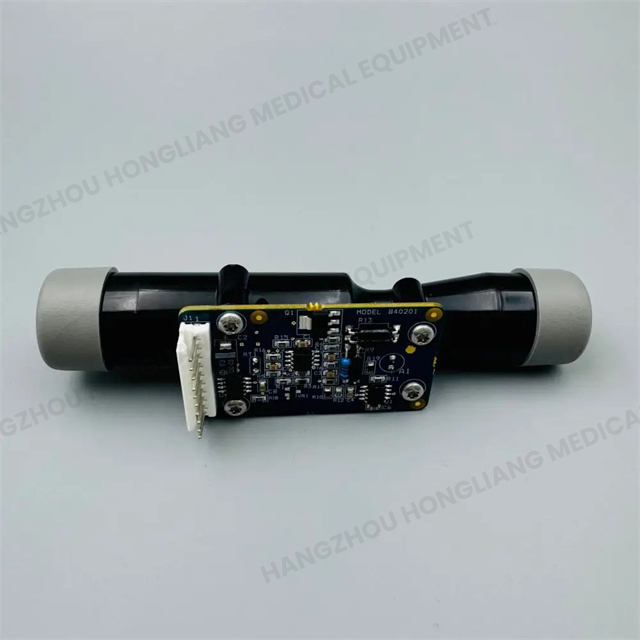
In critical care environments, ventilator efficacy relies entirely on the precision of pneumatic control systems. Inaccurate flow sensing leads to poor gas mixing, delayed trigger responses, and compromised patient safety. The 012-000021-00 air flow sensor serves as a critical replacement component. We engineer it to restore original baseline accuracy for high-acuity ventilators. It specifically manages flow rates up to 300 SLPM with minimal latency. This guide provides biomedical engineers and hospital procurement teams with a strict, evidence-based evaluation framework. You will learn how to verify, source, and implement this vital pneumatic part effectively. We will explore technical specifications, circuit integration, fleet compatibility, and risk management.
Core Specification: Operates on a 5VDC input, delivering a 0–4 VDC non-linear output with a wide flow measurement range of 0–300 standard L/min.
Clinical Precision: Achieves an accuracy of ±2.5% of reading (± 0.1 L/min at 21 °C) with an ultra-low response time of 5 milliseconds, ensuring safe low-flow rate sensitivity.
System Integration: Functions seamlessly within the pneumatic subsystems (Q1/Q2) of compatible ventilators (e.g., SynoVent E3/E5), acting as the primary data node before proportional valve gas mixing.
Procurement Standard: Qualified suppliers must provide documented pre-shipment engineering tests and a minimum 90-day to 24-month warranty against non-wear-and-tear failures.
Electrical demands form the foundation of sensor stability. The unit requires a highly stable 5 VDC power supply. A strict ± 5% tolerance prevents unwanted signal drift during operation. The sensor outputs a 0–4 VDC non-linear signal. This signal maps precisely to the integrated software algorithms of the ventilator. Unstable voltage disrupts this mapping process completely. You must ensure clean power from the internal board.
Pneumatic performance metrics directly dictate patient safety levels. The flow range scales effectively from 0 to 300 SLPM. We measure this in Standard Liters Per Minute. This wide range accommodates massive adult peak inspiratory flows effortlessly. It also handles delicate neonatal low-flow requirements safely. Baseline calibration yields an accuracy of ±2.5% of the reading. We validate this accuracy at 21 °C using medical air. A blazing fast 5 ms response time eliminates patient-ventilator asynchrony. It ensures the ventilator triggers exactly when the patient initiates a breath.
Material durability creates the physical baseline for long-term clinical use. The Mindray Flow Sensor 012-000021-00 withstands continuous clinical high-pressure environments. It resists internal wear caused by pressurized medical air over long clinical cycles. You can rely on its robust internal architecture during heavy ICU usage.
Parameter | Specification Value | Clinical Impact |
|---|---|---|
Input Voltage | 5 VDC (± 5%) | Ensures stable sensor operation without data signal drift. |
Output Signal | 0–4 VDC (Non-linear) | Maps exact flow curves to the ventilator control software. |
Flow Range | 0 to 300 SLPM | Supports both high adult and low neonatal flow demands. |
Accuracy | ±2.5% of reading | Guarantees exact tidal volume delivery to the patient. |
Response Time | 5 milliseconds | Prevents trigger delays and patient-ventilator asynchrony. |
The pneumatic circuit requires precise orchestration to function properly. The sensor acts as a critical gatekeeper inside this system. High-pressure gas first passes through initial filters and pressure regulators. The sensor then measures this regulated air instantly. It provides real-time feedback to the proportional valves. We identify these valves as PSOL1 and PSOL2. This constant data stream dictates the exact oxygen-air blending ratio.
Understanding the sensing mechanism explains its clinical superiority. You must contrast standard differential pressure mechanisms against these thermal sensing profiles. Thermal sensors measure mass flow directly using heat transfer principles. This specific response profile ensures ultra-high sensitivity. Unauthorized generic replacements often fail at these low flow rates. They cannot replicate the native thermal curve required by the software.
Protection dependencies heavily determine the actual sensor lifespan. Upstream filters play a massive role in preserving accuracy. We designate these filters as F1 and F2 in the service manual. They must successfully remove moisture and particulate impurities. If these filters fail, moisture hits the sensor wire. This ruins the calibration and triggers immediate flow alarms.
Consider this standard operational sequence for gas flow control:
High-pressure medical air enters the main ventilator block.
Upstream filters remove dangerous moisture and micro-particles.
Pressure regulators stabilize the incoming gas force accurately.
The flow sensor measures the exact gas volume passing through.
Proportional valves adjust the oxygen-air blend based on sensor data.
Primary equipment compatibility ensures seamless integration during critical repairs. This sensor directly supports the native pneumatic architecture of several devices. It fits the Mindray SynoVent E3 and E5 ventilators perfectly. It also integrates smoothly into relevant SV-series ventilators. These include the popular SV300, SV600, and SV800 models. The internal wiring harness matches the OEM pinout exactly.
Consolidated biomedical procurement saves immense administrative effort for hospitals. Hospital clinical engineering departments rarely manage a single brand. Efficient procurement requires sourcing various parts together. You might order this sensor alongside other critical components. A single vetted B2B distributor simplifies this complex supply chain.
Consider typical ecosystem examples in a modern hospital purchase order. You often combine different sub-components to maintain your diverse fleet.
You might source a Datex-Ohmeda Flow Sensor for your anesthesia machines.
Legacy fleet maintenance frequently demands a fresh Drager Oxygen Sensor.
Incubators and older gear might require a specialized Drager Service Kit Lamp LED.
Administrative hardware spares, such as a GE Printer Roller Assembly, keep patient monitors operational.
Apply a strict evaluation lens during vendor selection. Assess suppliers based on their order fulfillment capacity. They must accurately process complex, multi-brand OEM orders. High-tier aftermarket bills of materials require serious logistics management. Avoid vendors who carelessly mix incompatible sub-components in bulk shipments.
Avoiding counterfeit parts remains paramount for biomedical teams. Refurbishment risks also plague the secondary medical parts market. Apply highly skeptical criteria when evaluating "Original and New" claims online. Demand absolute transparency from your chosen supplier. Ask whether the part is factory-new OEM or New Old Stock. If refurbished, demand rigorous refurbishment documentation and testing logs.
Pre-shipment engineering testing guarantees out-of-the-box functionality for end users. Do not accept mere visual inspections as proof of quality. Vendors must provide tangible proof of pneumatic calibration. They should validate the signal output prior to dispatch. "Engineer Tested" labels mean nothing without corresponding flow calibration logs. These logs prove the sensor hits the required 300 SLPM peak.
Review the specific Warranty and Return Service Level Agreements. Industry standards dictate at least a 90-day functional warranty. Premium B2B suppliers often extend this coverage significantly. Some offer up to 24 months for non-human induced failures. However, natural degradation of the sensing element remains unavoidable. Wear and tear naturally happens over millions of breathing cycles. Policies generally exclude this standard degradation. Make sure your biomedical team understands these exact warranty limitations.
Installation realities dictate clinical success in the intensive care unit. Certified biomedical technicians must handle these sensitive components directly. They ensure O-rings and interface housings sit perfectly inside the pneumatic block. Micro-leaks at the connection point pose massive clinical risks. Even tiny air leaks invalidate the ±2.5% accuracy metric entirely. The ventilator will miscalculate the tidal volume delivered to the patient.
Post-installation software calibration is absolutely mandatory after physical installation. The ventilator must map the new sensor correctly. It reads the specific non-linear 0-4 VDC output curve. It then saves this unique curve to its baseline memory. Skipping this calibration creates dangerous volume delivery errors. The machine will trigger false flow alarms continuously.
Adopt a strict preventative replacement strategy for critical respiratory gear. High-acuity sensors offer excellent overall durability. However, you should evaluate them regularly during downtime. Check them during standard annual or bi-annual ventilator preventative maintenance schedules. Do not wait for a catastrophic "Flow Sensor Failure" alarm to act. Proactive replacement prevents unexpected downtime during high-census periods.
Maintenance Phase | Action Item | Frequency |
|---|---|---|
Visual Inspection | Verify O-ring seating and check for micro-leaks. | During installation and PM routines |
Software Calibration | Run internal ventilator flow mapping sequence. | Immediately post-installation |
Filter Check | Replace F1/F2 upstream filters to block moisture. | Every 6-12 months |
Component Swap | Exchange sensor before critical signal degradation occurs. | Every 12-24 months (based on usage) |
The Mindray 012-000021-00 Air Flow Sensor serves as an unforgiving component. Its 5ms response time remains completely non-negotiable for critical care. The 300 SLPM capacity directly ensures patient safety during peak inspiratory flows. We must prioritize these underlying technical truths above all else. Shortcutting on pneumatic parts always compromises the entire mechanical ventilation strategy.
Follow these action-oriented next steps for successful biomedical procurement. First, shortlist suppliers who provide explicit technical data sheets. Second, prioritize vendors with proven multi-brand consolidation capabilities. Third, seek transparent lead times, such as 3-5 days global air freight. Finally, demand documented pre-shipment pneumatic testing. This eliminates dead-on-arrival risks and gets your ventilators back online faster.
A: Most vetted medical parts distributors can dispatch in-stock inventory within 2-3 days. International air freight via DHL or FedEx takes an additional 5-10 business days. This timeframe ultimately depends on your local customs clearance procedures.
A: No. Even if the voltage matches, the specific 0–4 VDC non-linear output curve is unique. The 5ms response time remains proprietary to the ventilator's algorithmic requirements. Generic sensors risk dangerous over-delivery or under-delivery of tidal volumes.
A: Yes. Regardless of factory calibration, the ventilator's internal service software must run a specific routine. This flow sensor calibration sequence syncs the machine with the pneumatic resistance of the newly installed unit.
A: Specialized medical distributors typically support an MOQ of 1 piece. This accommodates hospital biomedical departments ordering for immediate repair needs. Volume discounts apply for fleet-wide preventative maintenance orders.