




Phone:
+86-187-5829-6389

Views: 0 Author: Site Editor Publish Time: 2026-09-09 Origin: Site
Precise expiratory control dictates patient-ventilator synchrony. The expiratory phase is just as important as inspiration in mechanical ventilation. Subpar exhalation control introduces severe physiological risks. These include increased expiratory work of breathing (WOB), auto-PEEP generation, delayed mechanical response times, and compromised waveform accuracy. Mechanical failures here directly impact patient outcomes. They increase the likelihood of barotrauma, cause hemodynamic instability, and prolong weaning times. Biomedical engineers, procurement teams, and clinical directors must understand the technical nuances of these pneumatic components. The expiratory valve serves as the primary gateway for pressure regulation and gas venting. Selecting the right component requires rigorous technical evaluation. This framework provides actionable engineering criteria to evaluate, select, and source high-performance valves. We will cover how to meet stringent regulatory standards, ensure seamless system integration, and provide reliable patient protection in critical care environments.
Active vs. Passive Control: Active exhalation valves utilizing servo-control technology offer superior pressure regulation and patient synchrony compared to traditional passive threshold resistors.
Performance Metrics & Protection: Evaluation must center on flow resistance, response latency, the management of pressure gradients, and the system's ability to provide reliable protection against barotrauma.
Compliance and Durability: Component selection requires rigorous assessment of material degradation under repeated sterilization cycles and adherence to ISO 80601-2-12 standards.
Supplier Reliability: Partnering with a vetted ventilator valve manufacturer mitigates supply chain risks and ensures consistent quality control for critical respiratory equipment parts.
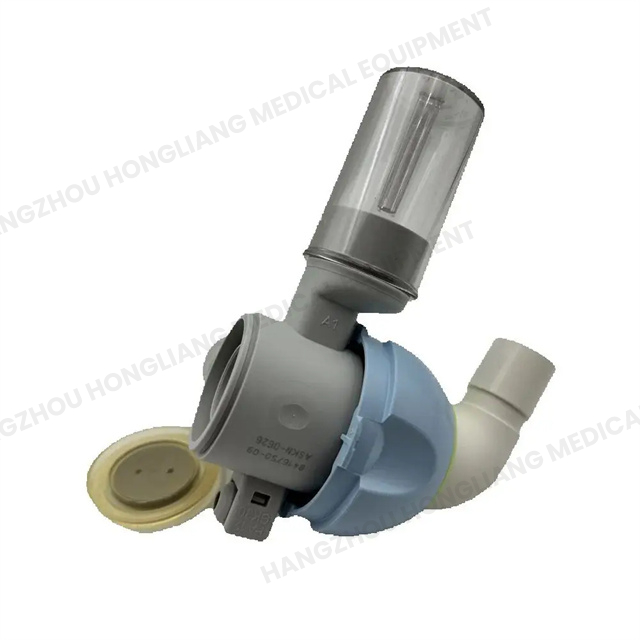
The exhalation block sits at the terminal end of the expiratory limb in a dual-limb patient circuit. It regulates the release of exhaled gas from the patient into the ambient environment or a dedicated scavenging system. The physical architecture typically consists of a rigid polymer housing, a flexible sealing membrane or diaphragm, and an electromechanical actuator. When the ventilator transitions from inspiration to expiration, the actuator adjusts the force applied to the membrane. This precise movement controls the size of the venting orifice.
Maintaining the baseline circuit pressure, known as Positive End-Expiratory Pressure (PEEP), is the most critical continuous function of this component. PEEP prevents alveolar collapse during exhalation, maintaining functional residual capacity and ensuring adequate oxygenation. The valve must hold this pressure steady despite continuous fluctuations in patient flow. Beyond maintaining PEEP, the component must rapidly vent exhaled carbon dioxide to prevent hypercapnia. It also manages dynamic pressure spikes caused by patient coughing, airway suctioning, or sudden changes in lung compliance.
Any imperfection in the seating surface between the membrane and the orifice immediately translates to baseline pressure drift. If the membrane fails to seat perfectly, gas escapes prematurely, causing the PEEP to drop below the set clinical target. Conversely, if the membrane sticks or the actuator applies too much force, gas is trapped in the circuit. This trapping leads to inadvertent auto-PEEP, which can severely compromise venous return to the heart and reduce cardiac output. The mechanical precision of this single component dictates the stability of the entire pneumatic system.
Traditional mechanical ventilation relied heavily on passive threshold resistors. These older designs utilized spring-loaded mechanisms, weighted diaphragms, or simple balloon valves to maintain pressure. Passive systems present a major clinical limitation: flow-dependent resistance. As the patient's expiratory flow rate increases, the resistance across a passive valve also increases. The patient must exert significant muscular effort to push air out of their lungs against this rising resistance. This added workload quickly leads to respiratory muscle fatigue, particularly in patients with compromised pulmonary mechanics.
Modern intensive care ventilators utilize an active exhalation valve. These advanced systems leverage microprocessor-regulated, servo-controlled voice coil actuators or high-resolution stepper motors. Instead of relying purely on mechanical tension, the active valve dynamically adjusts its position based on real-time feedback from proximal flow sensors and internal pressure transducers. The microprocessor continuously calculates the exact actuator position required to maintain the target pressure, regardless of the flow rate passing through the orifice.
This dynamic control enables biphasic ventilation capabilities. If a patient attempts to exhale or cough during a mandatory inspiratory breath, the microprocessor detects the sudden pressure spike. It instantly opens the active valve to release the excess air, preventing a high-pressure alarm and protecting the patient's lungs. This capability drastically improves patient comfort, reduces the need for heavy sedation, and minimizes the risk of the patient fighting the ventilator.
Feature | Passive Threshold Resistors | Active Servo-Controlled Valves |
|---|---|---|
Resistance Profile | Flow-dependent (resistance increases with higher flow rates) | Dynamic (adjusts orifice size to maintain target pressure regardless of flow) |
Actuation Mechanism | Mechanical springs, weighted diaphragms, or pneumatic balloons | Electromechanical voice coils or high-resolution stepper motors |
Response to Coughing | High resistance, leading to massive pressure spikes and patient discomfort | Instantaneous venting, releasing excess pressure to protect the airway |
Work of Breathing (WOB) | High imposed WOB, increasing the risk of respiratory muscle fatigue | Minimal imposed WOB, promoting patient-ventilator synchrony |
Primary Application | Transport ventilators, older legacy systems, basic CPAP devices | Modern intensive care ventilators, advanced biphasic ventilation modes |
Mechanical ventilation operates entirely on the principle of positive pressure gradients. The ventilator generates a positive pressure air source that drives gas into the lungs during inspiration. This force overcomes the natural airway resistance and the elastic recoil of the lung tissue. The expiratory phase relies on the potential energy stored in the expanded lungs and chest wall to reverse this gradient. The elastic recoil pushes gas back out through the endotracheal tube and down the expiratory limb toward the exhalation block.
The valve must manage this reversing pressure gradient seamlessly. Peak airway pressure and plateau pressure are continuously measured by the ventilator's internal transducers. The control algorithm uses these precise measurements to calculate the exact degree of closure required to hit the target PEEP. The system must account for the pneumatic resistance of the breathing circuit itself, which causes a slight pressure drop between the patient's airway and the exhalation block.
If the valve closes too slowly at the end of exhalation, the circuit pressure drops below the PEEP setting. This undershoot risks alveolar derecruitment and hypoxemia. If the valve closes too quickly, it traps pressure in the circuit, leading to auto-PEEP and potential barotrauma. The microprocessor must predict the deceleration of expiratory flow and adjust the voice coil actuator in real-time to achieve a soft, precise landing at the exact PEEP target.
Valve responsiveness directly dictates the accuracy and morphology of the pressure-time and flow-time graphics displayed on the ventilator screen. Clinicians rely heavily on these waveforms to assess lung mechanics, detect circuit leaks, and identify patient-ventilator asynchrony. The mechanical performance of the exhalation block is immediately visible in these scalars. A sluggish valve will produce a rounded, prolonged expiratory flow curve, falsely suggesting high airway resistance or bronchospasm.
Conversely, a valve that chatters or oscillates due to a failing actuator will introduce high-frequency noise into the pressure waveform. This noise makes it difficult for clinicians to accurately measure plateau pressure or assess static lung compliance. Accurate interpretation of these graphics is essential to reduce clinical risks and guide weaning strategies. When the mechanical component perfectly tracks the microprocessor's commands, the resulting waveforms provide a true reflection of the patient's pulmonary status.
Biomedical technicians use these same waveforms during routine maintenance to diagnose pneumatic faults. A sudden drop in the pressure waveform at the start of inspiration often indicates a sticking expiratory membrane that is slow to close. A delayed return to baseline flow on the flow-time scalar can indicate increased resistance within the exhalation block itself, often caused by moisture buildup or material degradation.
Expiratory work of breathing is a critical metric in assessing overall ventilator performance. The internal pneumatic resistance of the ventilator expiratory valve must be minimized to prevent respiratory muscle exhaustion. When a patient exhales, they must generate enough force to push gas through the endotracheal tube, the expiratory limb, and finally through the exhalation block. Any unnecessary resistance at the block adds to the imposed WOB.
Acceptable resistance thresholds during the expiratory phase are strictly defined by international standards. Generally, the pressure drop across the fully open valve must remain below 2 to 3 cmH2O at a continuous flow rate of 60 liters per minute. High-performance biphasic active valves excel in mitigating this impedance. They achieve this by utilizing highly responsive voice coils that pull the membrane completely clear of the venting orifice during peak expiratory flow.
This low-resistance profile is particularly vital when spontaneous breathing occurs during the ventilator's inspiratory phase. If a patient initiates an active exhalation while the machine is delivering a mandatory breath, the active valve must vent the incoming flow instantly. Failure to do so results in massive pressure spikes and severe patient discomfort. Bench studies consistently demonstrate that servo-controlled valves significantly reduce this superimposed WOB compared to older pneumatic designs, directly facilitating faster weaning from mechanical support.
Maintaining stable PEEP is non-negotiable for adequate oxygenation in critically ill patients. The valve must prevent pressure overshoots during the rapid transition from inspiration to expiration. It must also maintain a rock-steady baseline without pressure drops or oscillations. This requires precision measurement from the internal pressure transducers and continuous micro-adjustments by the servo motor. The Proportional-Integral-Derivative (PID) controller in the ventilator's software constantly calculates the error between the measured pressure and the target PEEP, adjusting the actuator current accordingly.
Furthermore, the valve acts as the primary mechanical fail-safe for the entire pneumatic system. System design requirements mandate reliable protection mechanisms against barotrauma and volutrauma. If the internal pressure transducers detect a critical overpressure event, the system must react instantly. This can occur due to an occluded expiratory limb, a sudden severe cough, or a failure in the inspiratory proportional solenoid.
When an overpressure threshold is breached, the valve must default to a fully open, rapid-venting state. This emergency pressure relief function must operate independently of the primary software control loop. In many designs, cutting power to the voice coil actuator causes a return spring to force the valve wide open. This hardware-level fail-safe guarantees patient safety under catastrophic failure conditions, ensuring that airway pressure immediately drops to ambient levels.
The performance of an active valve is entirely dependent on its servo-loop latency. This latency is the total time elapsed between a physiological event and the mechanical correction. For modern critical care ventilators, this entire cycle must occur in milliseconds. Any delay in this feedback loop results in phase lag, which disrupts patient synchrony and degrades the accuracy of breath-to-breath volume calculations.
The internal pressure transducer detects a sudden change in airway pressure caused by patient effort.
The analog-to-digital converter processes the raw sensor voltage and sends the digital signal to the main microprocessor.
The control algorithm calculates the required change in valve position to maintain the target pressure.
The digital-to-analog converter sends the precise electrical current to the voice coil actuator.
The electromechanical actuator physically moves the silicone membrane to adjust the venting orifice size.
Benchmarks for high-tier intensive care systems require total response times of less than 10 to 15 milliseconds. Phase lag manifests clinically as pressure overshoot during early exhalation or a delayed return to baseline PEEP. If the latency is too high, the valve will constantly chase the target pressure, resulting in a fluctuating baseline that triggers nuisance alarms and causes patient discomfort.
Designing the physical membrane of the valve involves a strict engineering trade-off between material durability and pressure sensitivity. The membrane must be robust enough to withstand high-velocity gas flow, heated humidification, and harsh chemical environments. It must endure the physical impact of seating against the rigid orifice millions of times over its operational lifespan. However, it must also remain thin and pliable enough to respond instantly to micro-pressure adjustments commanded by the servo actuator.
Manufacturers typically utilize specialized medical-grade Liquid Silicone Rubber (LSR) or high-performance elastomers. The Shore A hardness of the silicone is carefully calibrated. A membrane that is too thick or rigid will exhibit hysteresis. It will fail to return to its exact neutral position after actuation, which causes PEEP instability and inaccurate flow measurements. The actuator will have to work harder to deform the thick material, increasing power consumption and heat generation.
Conversely, a membrane that is too thin will fatigue rapidly. The constant flexing will lead to micro-tears in the silicone structure. These micro-tears cause insidious gas leaks that are difficult to detect during routine use. The ventilator will attempt to compensate for the leak by increasing baseline flow, but eventually, the leak will exceed the compensation limits, leading to catastrophic failure during ventilation. Engineering teams must find the exact material formulation that balances these competing requirements.
Reusable expiratory cassettes must endure rigorous infection control protocols between patients. High-temperature steam sterilization, typically autoclaving at 134°C for extended periods, takes a severe toll on polymer structures. Aggressive chemical disinfection using glutaraldehyde or hydrogen peroxide vapor also accelerates material degradation. Over repeated cycles, silicone components experience cross-linking breakdown and depolymerization.
This chemical breakdown results in hardening, loss of elasticity, and severe calibration drift. The membrane becomes stiff and unresponsive, increasing the imposed work of breathing and causing PEEP fluctuations. Biomedical teams must carefully track the exact number of sterilization cycles each block undergoes. Most manufacturers specify a strict limit, often between 50 and 100 autoclave cycles, before the internal seals and membranes must be discarded and replaced.
When evaluating single-use disposable valves versus reusable components, facilities must weigh operational simplicity against environmental impact. Disposable valves guarantee baseline performance out of the package, eliminating the risk of degradation-induced failures. However, they require massive storage space and generate significant medical waste. Regardless of the choice, the materials used must be biocompatible and must not release volatile organic compounds (VOCs) when exposed to heated breathing gases.
Integrating new valve designs into existing ventilator platforms presents complex engineering challenges. The physical dimensions of the exhalation block must perfectly match the legacy pneumatic pathways. Any misalignment between the block and the ventilator housing will cause turbulent flow, unintended resistance, and massive gas leaks. The seating mechanism must lock securely to withstand the high pressures generated during recruitment maneuvers.
Furthermore, the valve must interface flawlessly with the ventilator's existing precision measurement sensors. Many exhalation blocks house the proximal flow sensor connections or internal pressure transducer ports. Sourcing replacement respiratory equipment parts requires verifying that the new component does not alter the system's baseline compliance or resistance values. The internal volume of the block contributes to the total pneumatic dead space of the circuit.
If a replacement valve introduces even a slight change in pneumatic dead space or flow dynamics, the ventilator's internal software algorithms will calculate inaccurate tidal volumes. The machine will deliver incorrect volumes to the patient, directly jeopardizing care. Engineering teams must validate that the internal geometry of the replacement part perfectly mirrors the original equipment to ensure the software algorithms remain accurate.
Sourcing critical pneumatic components requires strict adherence to international regulatory standards. A reputable ventilator valve manufacturer must maintain active ISO 13485 certification. This certification demonstrates a comprehensive quality management system specifically tailored to the design and manufacture of medical devices. It ensures that every component off the assembly line meets exact dimensional and performance tolerances.
Furthermore, components intended for clinical use require extensive regulatory clearance. In the US market, this means FDA 510(k) clearance documentation, proving substantial equivalence to existing safe devices. In Europe, it requires CE marking under the stringent Medical Device Regulation (MDR). Procurement teams must demand detailed bench testing protocols from potential suppliers before approving any component for clinical use.
This documentation should include empirical data on flow-resistance curves, proving the valve meets the 2-3 cmH2O threshold at 60 L/min. It must include endurance testing data, demonstrating the valve's performance under simulated high-stress lung conditions over millions of actuation cycles. Suppliers must also provide validation of the active exhalation valve's performance across the full spectrum of adult, pediatric, and neonatal flow rates, ensuring versatility across different patient populations.
The decision to source proprietary Original Equipment Manufacturer (OEM) parts versus third-party aftermarket alternatives carries significant operational weight. OEM parts guarantee absolute compatibility and preserve existing warranty agreements. They are engineered specifically for the ventilator's software algorithms. However, OEM parts often come with extended lead times during global supply shortages, leaving hospitals vulnerable to equipment downtime.
Third-party components can offer vital supply chain flexibility and faster delivery times. However, when sourcing specific replacements, such as aftermarket Draeger ventilator parts, clinical engineering teams must implement a rigorous validation framework. The aftermarket component must meet or exceed the original pressure gradient specifications, response latency benchmarks, and material durability standards.
Any deviation in the physical seating of the valve or the elasticity of the membrane will trigger ventilator alarm states. If the aftermarket membrane is slightly too stiff, the ventilator will register a high PEEP alarm. If the housing dimensions are off by a fraction of a millimeter, it will fail the automated pre-use leak test. Biomedical teams must test aftermarket parts on calibrated test lungs across all ventilation modes before clearing them for patient use.
The resilience of the supply chain is just as critical as the technical specifications of the component. When selecting a ventilator accessories supplier, hospitals and engineering firms must evaluate the supplier's manufacturing capacity and geographic redundancy. A single point of failure in the supply chain can ground an entire fleet of life-saving ventilators, severely impacting hospital surge capacity.
Key criteria include the supplier's ability to guarantee lead times during demand surges. Procurement teams must investigate the supplier's raw material sourcing strategies. Do they rely on a single source for medical-grade silicone? Do they have safety stock buffered in multiple geographic locations? These factors determine whether the supplier can deliver parts during a global crisis.
Furthermore, evaluate their track record of consistent quality control across large production batches. A supplier might provide a perfect prototype, but fail to maintain tolerances during mass production. Transparent communication regarding manufacturing locations, quality control rejection rates, and inventory buffering strategies is a mandatory requirement for any long-term supplier partnership.
Before deploying any new or newly sterilized expiratory block into clinical circulation, biomedical engineering technicians must execute stringent pre-deployment bench studies. These tests verify valve performance under simulated lung conditions using a calibrated test lung and a high-precision pneumatic analyzer. Technicians must vary the compliance and resistance settings on the test lung to simulate different patient pathologies, such as stiff ARDS lungs or highly compliant COPD lungs.
During these simulations, the technician monitors the ventilator's pressure waveforms and compares them to the readings on the independent pneumatic analyzer. They must ensure the valve maintains target PEEP without oscillation across different flow rates. They must verify that the valve responds instantly to simulated spontaneous breaths without causing massive pressure drops. They must also confirm that the valve does not trigger false disconnect or occlusion alarms during rapid changes in lung mechanics.
The automated pre-use check built into the ventilator software is not sufficient for full validation of a new component. The pre-use check only verifies basic leak rates and sensor calibration. It does not test the dynamic response of the voice coil actuator under heavy load. Only after passing these dynamic flow tests on a pneumatic analyzer should the component be cleared for patient use.
Robust standard operating procedures (SOPs) are required to maintain the integrity of the exhalation block over its lifecycle. Routine inspection protocols must be strictly enforced by the biomedical engineering department. These protocols prevent unexpected mid-ventilation failures that compromise patient safety.
Perform a visual inspection of the silicone membrane for micro-tears, discoloration, or hardening before every patient use.
Inspect the rigid polymer housing for hairline cracks caused by physical impact or thermal stress during autoclaving.
Clean the internal seating orifice to remove any buildup of dried patient secretions or aerosolized medications, which can cause the valve to stick.
Execute a high-pressure leak test using a pneumatic analyzer to quantify any gas escape past the primary seal.
Replace all internal O-rings, seals, and diaphragms strictly according to the manufacturer's specified preventative maintenance (PM) schedule, regardless of visual appearance.
Leak testing is a critical daily procedure. The ventilator's automated pre-use check will pressurize the circuit and measure the pressure drop over time. If the exhalation block fails the leak test, it must undergo immediate recalibration or replacement. BMETs must never attempt to bypass a failed leak test, as this guarantees inaccurate volume delivery to the patient.
Proactive identification of valve degradation prevents catastrophic clinical events. Clinicians and technicians must be trained to recognize the early warning signs of pneumatic failure. Catching these issues early allows for planned maintenance rather than emergency intervention during critical patient care.
Failure Mode | Clinical Indicator | BMET Action |
|---|---|---|
Membrane Hardening (Loss of Elasticity) | Insidious baseline pressure drift; ventilator struggles to maintain steady PEEP, fluctuating by >1-2 cmH2O. | Replace the silicone membrane; verify autoclave cycle count; recalibrate pressure sensors. |
Actuator Sticking (Secretion Buildup) | Erratic flow waveforms; jagged expiratory flow curves; delayed return to zero flow on the scalar. | Disassemble the block; perform deep chemical cleaning of the orifice; verify voice coil movement. |
Micro-tears in Diaphragm | Increase in the ventilator's automatic leak compensation values; failure of automated pre-use leak test. | Discard and replace the diaphragm immediately; inspect housing for sharp edges causing the tears. |
Voice Coil Electrical Failure | Complete loss of PEEP; continuous high-priority disconnect or low-pressure alarms. | Replace the entire exhalation block assembly; test electrical contacts on the ventilator housing. |
When these indicators arise, the clinical team must immediately swap the exhalation cassette and send the suspect unit to biomedical engineering. The BMET team will perform a tear-down, root-cause analysis, and component replacement. Documenting these failure modes helps identify trends, such as a specific batch of aftermarket parts failing prematurely or a sterilization protocol causing accelerated degradation.
Request comprehensive flow-resistance curves and endurance testing data from prospective suppliers before initiating any pilot testing phase.
Implement strict bench testing protocols using calibrated test lungs to verify aftermarket component compatibility across varying compliance and resistance settings.
Establish rigid tracking systems for reusable exhalation blocks to monitor sterilization cycles and prevent material fatigue failures.
Audit potential manufacturing partners for active ISO 13485 certification and robust supply chain redundancy to ensure uninterrupted access to critical parts.
A: The expiratory valve regulates the release of exhaled air from the patient circuit. It maintains Positive End-Expiratory Pressure (PEEP) to prevent alveolar collapse, manages dynamic pressure gradients, vents exhaled carbon dioxide, and acts as a primary mechanical fail-safe to protect the patient from excessive airway pressures.
A: An active valve uses microprocessors and servo-controlled actuators to dynamically adjust resistance based on real-time patient effort and circuit pressure. This significantly reduces the work of breathing, especially if the patient exhales during the inspiratory phase, whereas passive spring-loaded valves have fixed, flow-dependent resistance.
A: It serves as the primary pressure-relief mechanism in the pneumatic circuit. If internal sensors detect a dangerous pressure spike that exceeds safe physiological thresholds, the active valve instantly defaults to a fully open position, rapidly venting excess pressure to prevent barotrauma and volutrauma.
A: Common causes of failure include material degradation of the silicone membrane from repeated high-temperature sterilization, the buildup of dried patient secretions or nebulized medications causing the mechanism to stick, and electronic or pneumatic control failures within the servo-loop.
A: Replacement schedules depend entirely on manufacturer-specific guidelines and the exact number of autoclave cycles the component has endured. Routine bench testing and automated pre-use leak tests are critical to identify calibration drift or material fatigue before the part fails during clinical use.
A: Yes, but it requires rigorous validation. You must conduct comprehensive compatibility testing and verify regulatory clearance. The aftermarket part must perfectly match the OEM's flow-resistance profiles, physical dimensions, and precision measurement specifications to avoid triggering ventilator alarms.
A: Prioritize suppliers with active ISO 13485 certification, transparent and verifiable bench testing data, robust internal quality control processes, and reliable supply chain logistics that include geographic redundancy to guarantee part availability during demand surges.